Classics · Covers · Wharton · writing

Covers: The Age of Innocence

I read Edith Wharton’s The Age of Innocence years ago and listened to an audio version of it after I completed my A Studio on Bleecker Street. I mention this because in my recent revisit to the novel set in 1870s Gilded Age New York, I realized how many elements of Studio related to elements in Age. Indeed, my characters occupy space that Wharton’s characters occupy at just about the same time.
My Bowman family lives not far from the Archers and Wellands but in one way–and I say this pretentiously–my heroine Clara Bowman does what Wharton’s hero Newland Archer does not do. This makes my story…different and [spoiler alert] not as sad.

That said, The Age of Innocence begins at the New York Academy of Music. Within not many years–and the novel was published in 1920 but set in the 1870s (except for the final scenes)–the Academy would be eclipsed as the venue-of-the-upper-class by the Metropolitan Opera. The opening scene at the Academy is quite alive, combining the novel’s three main characters, most ominously Countess Ellen Olenska.

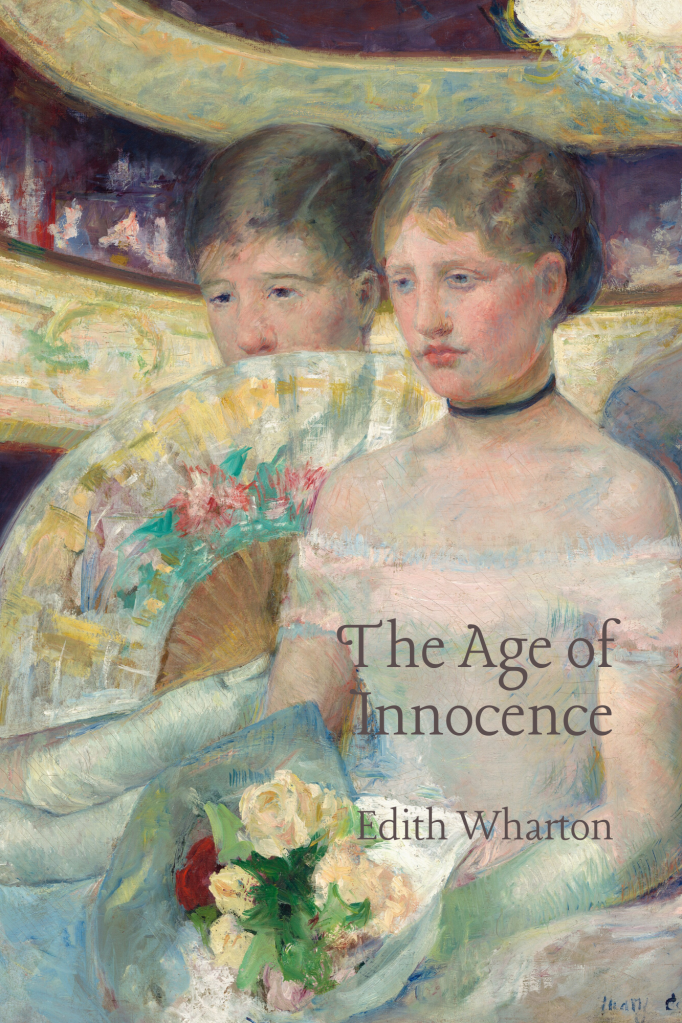
The cover for this was clear. The American Mary Cassatt did a number of Impressionist paintings at the Paris Opera. So to the Paris Opera it was, and the cover is from 1878-1880, only a year or two after the events of Age of Innocence. A side note: my heroine, Clara, spent time in Paris studying the artists there; turning to art was her means of overcoming the tragic loss of her best friend and of that friend’s brother, who all knew Clara would marry. (Excerpt.)

The painting is one of several set there, but this one, at the National Gallery, is published free of all rights, i.e., a CC0 designation. The National Gallery describes it:

Shown from the knees up, two young women with pale, peachy skin wearing white gowns sit close together and almost fill this vertical painting. The women are angled to our left and look in that direction. The young woman on our right has a heart-shaped face, dark blond hair gathered at the back of her head, and light blue eyes. Her full, coral-pink lips are closed, the corners in greenish shadows. Her dress is off the shoulders, has a tightly fitted bodice, and the skirt pools around her lap. The fabric is painted in strokes of pale shell pink, faint blue, and light mint green but our eye reads it as a white dress. She wears a navy-blue ribbon as a choker and long, frosty-green gloves come nearly to her elbows. She holds a bouquet in her lap, made up of cream-white, butter-yellow, and pale pink flowers with grass-green leaves and one blood-red rose. Her companion sits just beyond her on our left and covers the lower part of her face with an open fan. The fan is painted in silvery white decorated with swipes of daffodil yellow, teal green, and coral red. She has violet-colored eyes, a short nose, and her dark blond hair is smoothed over the top of her head and pulled back. She also wears long gloves with her arms crossed on the lap of her ice-blue gown. Along the right edge of the painting, a sliver of a form mirroring the torso, shoulder, and back of the head of the young woman to our right appears just beyond her shoulder, painted in tones of cool blues. Two curving bands in golden yellow and spring green swiped with darker shades of green and gold arc behind the girls and fill the background. The space between the curves is filled with strokes of plum purple, dark red, and pink. The artist signed the lower right, “Mary Cassatt.”
Classics · Covers · writing

Covers: North and South

As Róisín Campbell is onboard the City of Paris, the steamship that is taking her to America, she is trepidatious about what her fate will be. She can read, and has read romances:

Róisín was not so foolish as to believe a well-bred and handsome gentleman would carry her away, notwithstanding how often it happened in the romances she read and re-read. She knew they were fantasies, and that no man of a good family would marry a farmgirl, no matter how handsome he might think her. To such a family, she would be little better than the poor from the west of Ireland who could barely speak let alone read English. She knew there would be many a man in a good family who would seek to take advantage of her, promising her all manner of things to seduce her and that such a man would be her ruination. There were many such rakes in her books too.

But, really, what was awaiting this woman raised on a farm in County Limerick who’d never seen the sea till she was in Queenstown, ready to board the City of Paris? What she “knew” was what she read in the more serious books:

Still, she feared she would end up in the squalor she read about in other, more serious books set in London and Manchester and prayed that that would not be her fate.

The London reference is to Dickens. And “Manchester” is “Milton,” the northern city, and completely different world, to which Margaret Hale is forced to move after her father loses his position in a calm vicarage in the English south. So the cover for Elizabeth Gaskell’s novel North and South required some thought.

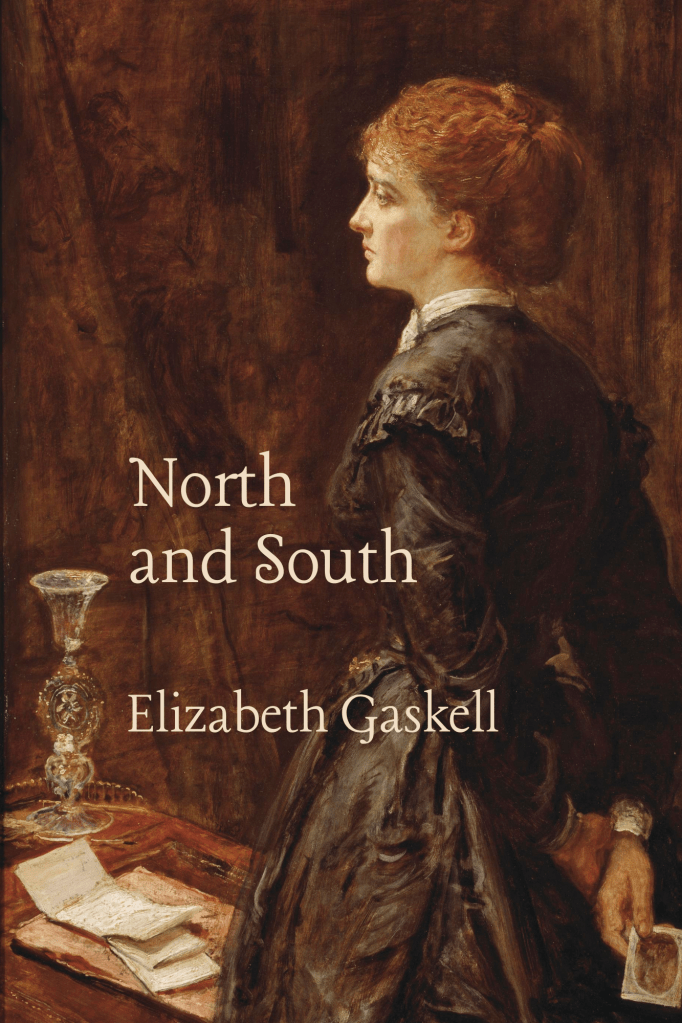
This is the only cover I’ve gotten from the Yale Art Gallery. It is Yes or No by the British artist Sir John Everett Millais. It was painted in 1871, so it is not too out of date for the novel, which was published in 1854. Yes or No? North or South?

I could find nothing about the painting from Yale, but the Met has a description of a drawing made of it:

A contemplative woman stands near an open letter, holding a small picture behind her back. The print reproduces a painting that Millais exhibited at the Royal Academy of Arts, London in 1871 (no. 1055) (Yale University Art Gallery), where the subject’s black gown indicates that she is in mourning. It was first published in London by Thomas Agnew & Sons in 1873, and this later variation issued a few years later in New York by the Kendall Bank Note Company.

Yes or No indeed.

Austen · Classics · Covers · writing

Covers: Pride and Prejudice

For my conversion of covers to avoid any rights issues, I did searches of those institutions that have Open Access policies, i.e., they allow the use of their images of works in the public domain for any purposes. I searched for portraits in various periods and from various places. This brought up a large number of images, from which I selected a bunch for possible cover use.

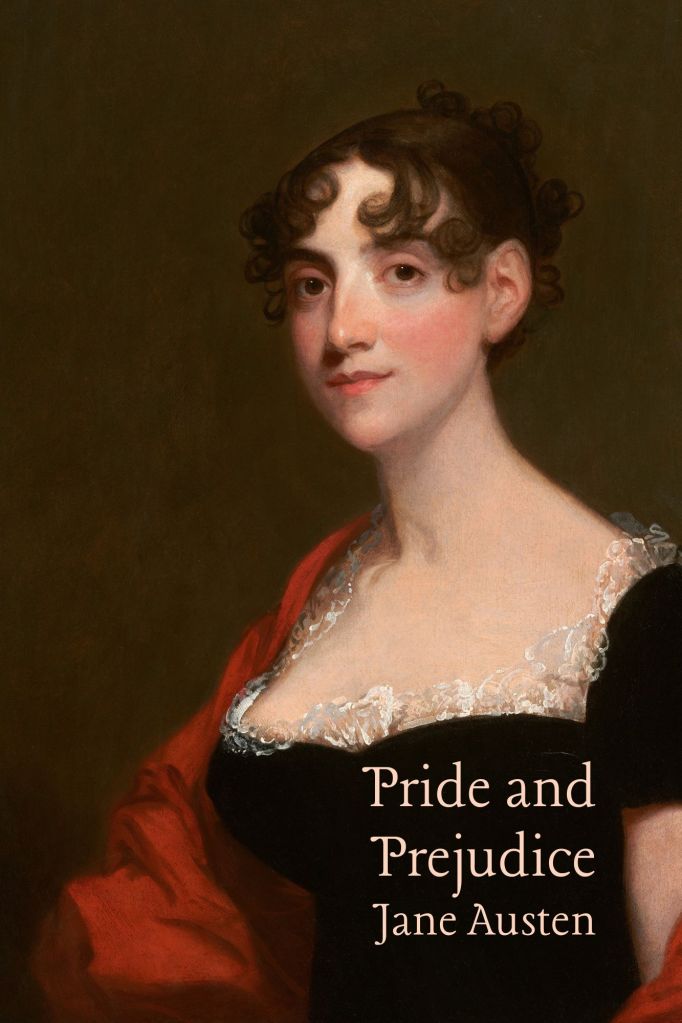
Ann Calvert Stuart Robinson (Mrs. William Robinson), c. 1804, by Gilbert Stuart

Elizabeth Bennet is one of literature’s iconic figures. As I went through my little collection, I wanted someone who could be Elizabeth Bennet. Though for some covers I’ve gone outside the time period, for P&P and my other Austens I needed to keep to it.

The painting I use is of a 19 or 20 year-old and it was done in 1804. So, she is Elizabeth’s age and the date is only a few years before the book’s story. The portrait is from The National Gallery in Washington.

We happen to know quite a lot about the woman in the painting. The National Gallery of Art has several pages about her in its American Paintings of the Eighteenth Century (246-249).

She is Ann Stuart, who was born in Fairfax County, Virginia in 1784. Her aunt described her mother about Ann Stuart and her sister in a manner that will sound familiar to P&P readers: “their mother paid scant heed to their education and brought them up as if they were to marry English lords, and I don’t believe they accept the offers made to them.”

That aunt would later write of her:

The eldest of the Stuart girls is a very nice girl, but she now lives quite far away in Virginia. Her father, whom I am sure you remember as an extremely austere and tedious man — completely respectable, but more knowledgeable about the customs of the Greeks and Romans than of today — forced her against her will to marry a man who does not have enough intelligence to make a woman such as she happy. Although she writes me that she is perfectly [content], I do not believe it.

Ann Stuart wrote to a friend in 1807:

You would be surprised to see what a change has taken place in my taste, instead of reading or writing all day and being out of humor when interrupted I am quite active about the Farm and garden and very solicitous to do something in that way to entitle me to become a member of the agricultural society.

She had two children, boys, and is thought to have died in 1823. She was thirty-nine.