Classics · Covers · writing

Covers: North and South

As Róisín Campbell is onboard the City of Paris, the steamship that is taking her to America, she is trepidatious about what her fate will be. She can read, and has read romances:

Róisín was not so foolish as to believe a well-bred and handsome gentleman would carry her away, notwithstanding how often it happened in the romances she read and re-read. She knew they were fantasies, and that no man of a good family would marry a farmgirl, no matter how handsome he might think her. To such a family, she would be little better than the poor from the west of Ireland who could barely speak let alone read English. She knew there would be many a man in a good family who would seek to take advantage of her, promising her all manner of things to seduce her and that such a man would be her ruination. There were many such rakes in her books too.
But, really, what was awaiting this woman raised on a farm in County Limerick who’d never seen the sea till she was in Queenstown, ready to board the City of Paris? What she “knew” was what she read in the more serious books:

Still, she feared she would end up in the squalor she read about in other, more serious books set in London and Manchester and prayed that that would not be her fate.

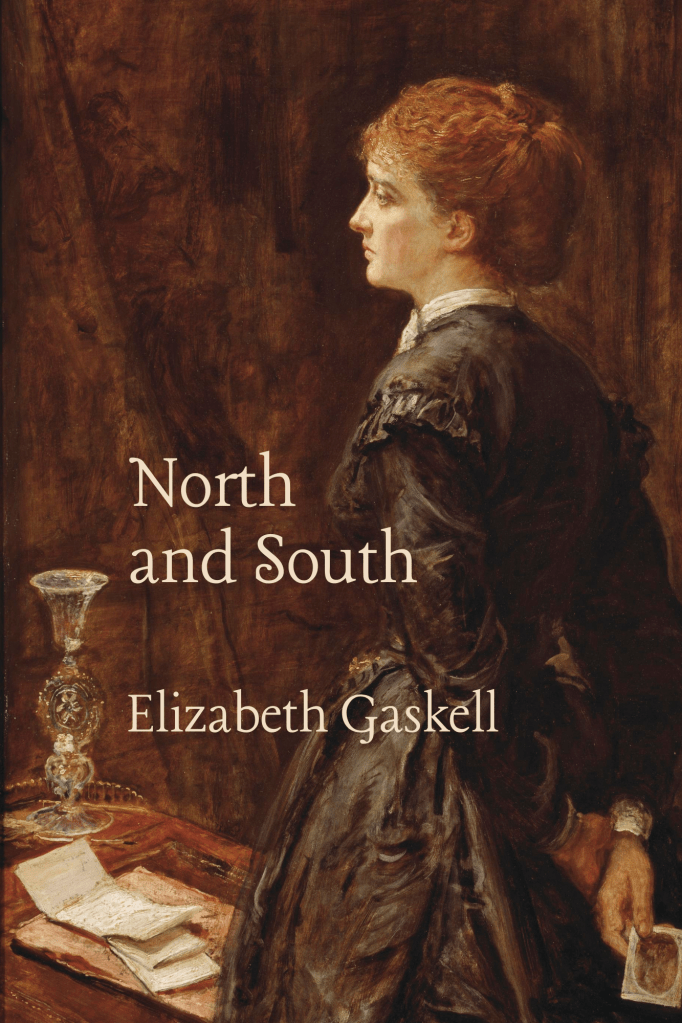
The London reference is to Dickens. And “Manchester” is “Milton,” the northern city, and completely different world, to which Margaret Hale is forced to move after her father loses his position in a calm vicarage in the English south. So the cover for Elizabeth Gaskell’s novel North and South required some thought.

This is the only cover I’ve gotten from the Yale Art Gallery. It is Yes or No by the British artist Sir John Everett Millais. It was painted in 1871, so it is not too out of date for the novel, which was published in 1854. Yes or No? North or South?

I could find nothing about the painting from Yale, but the Met has a description of a drawing made of it:

A contemplative woman stands near an open letter, holding a small picture behind her back. The print reproduces a painting that Millais exhibited at the Royal Academy of Arts, London in 1871 (no. 1055) (Yale University Art Gallery), where the subject’s black gown indicates that she is in mourning. It was first published in London by Thomas Agnew & Sons in 1873, and this later variation issued a few years later in New York by the Kendall Bank Note Company.

Yes or No indeed.

Classics · writing

Covers: Persuasion

And so we reach Austen’s last, and my favorite, novel. Persuasion.

Anne Elliot is older than the other heroines. She, or at least Miss Austen suggests, has lost some of such beauty as she had in her early twenties, in contrast to her older sister Elizabeth.
She is, of course, a far more attractive woman than her sisters in almost all other respects. Here, I found an 1810 portrait of Mary Fairlie Cooper, from the Cleveland Museum of Art. Again, I know nothing about her and was unable to find anything. As particularly with the portrait that could be Lizzy Bennet, this could be Anne Elliot.

And with this, I conclude with my Austen covers.

Classics · writing

Covers: Northanger Abbey

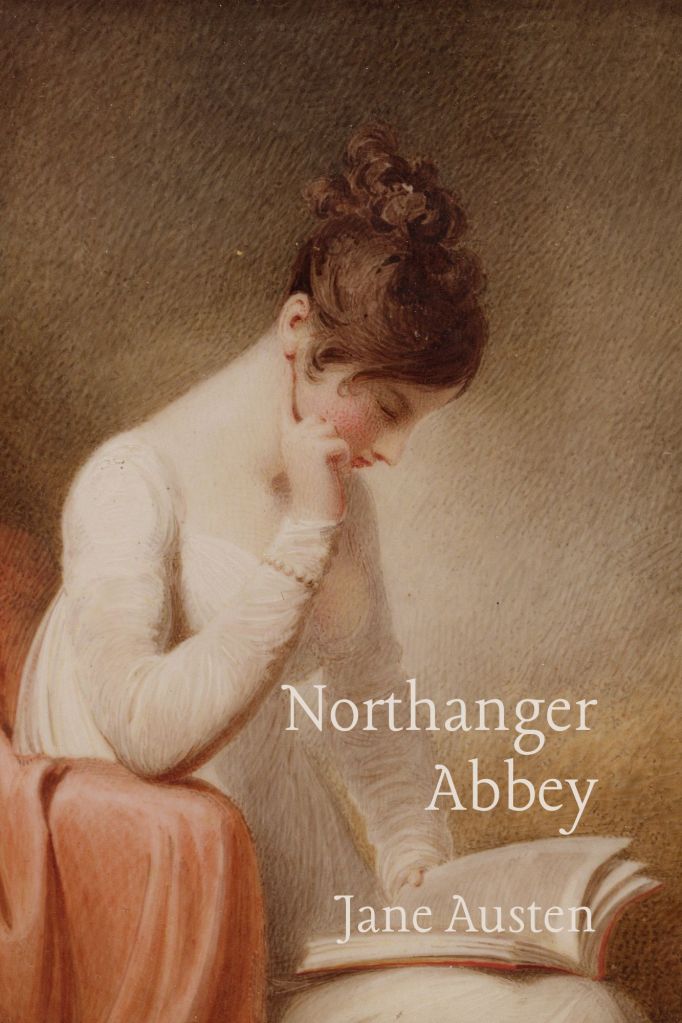
Northanger Abbey is likely Austen’s least known novel. Since the heroine Catherine Morland is a dedicated reader, I was looking for a reader.

I came up An Interesting Story (Miss Ray) from the Met. It is actually a miniature, measuring 4 3/4 x 3 7/8 in. It was done in 1806 on Ivory.

The artist is the Brit William Wood. I’ve been unable to find any information about the subject. Nor have I found anything but the dates for Wood, which are 1769-1810.

Classics · writing

Covers: Emma

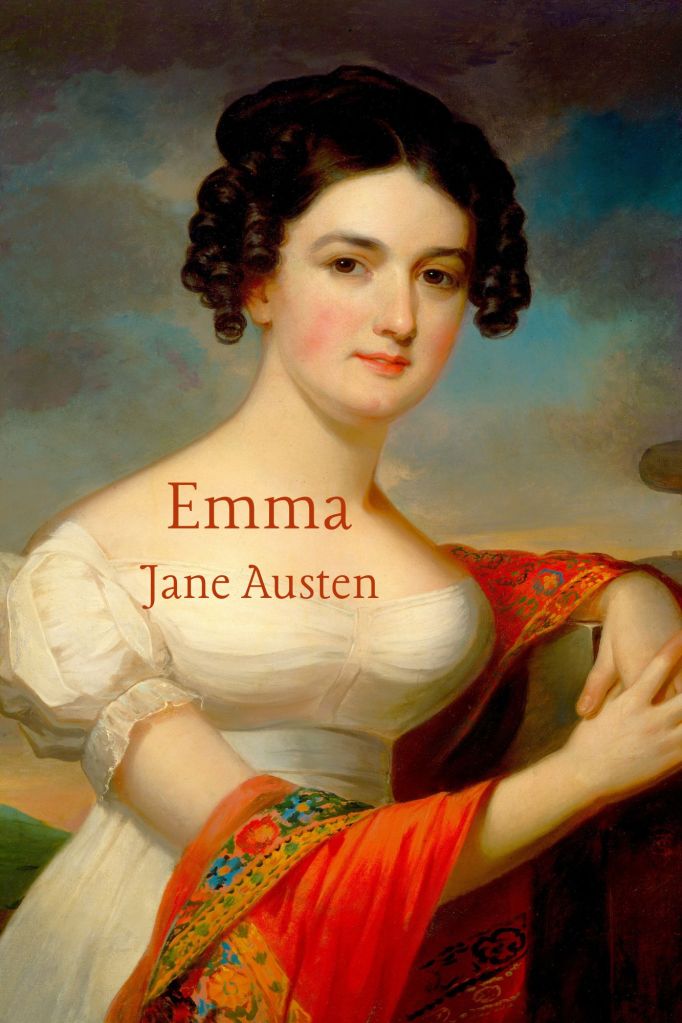
I have far an away the most information about the two Gilbert Stuart portraits from the National Gallery for Pride and Mansfield than I do for any others. This next one, Emma, happens to also be from the National Gallery but I can find nothing about the sitter beyond her name (and that her daughter may have been the de facto first lady as John Tyler’s sister-in-law after Tyler became a widower).

Emma is not a favorite of mine. For this cover, though, I wanted a mischief maker. I found Julianna Hazlehurst, painted around 1820 by Jacob Eichholtz. I particularly like the slight bit of her teeth showing.

This painting has hung in the chambers of Chief Justice Rehnquist and in the residence of the U.S. Ambassador to the Czech Republic in Prague.

Classics · writing

Covers: Mansfield Park

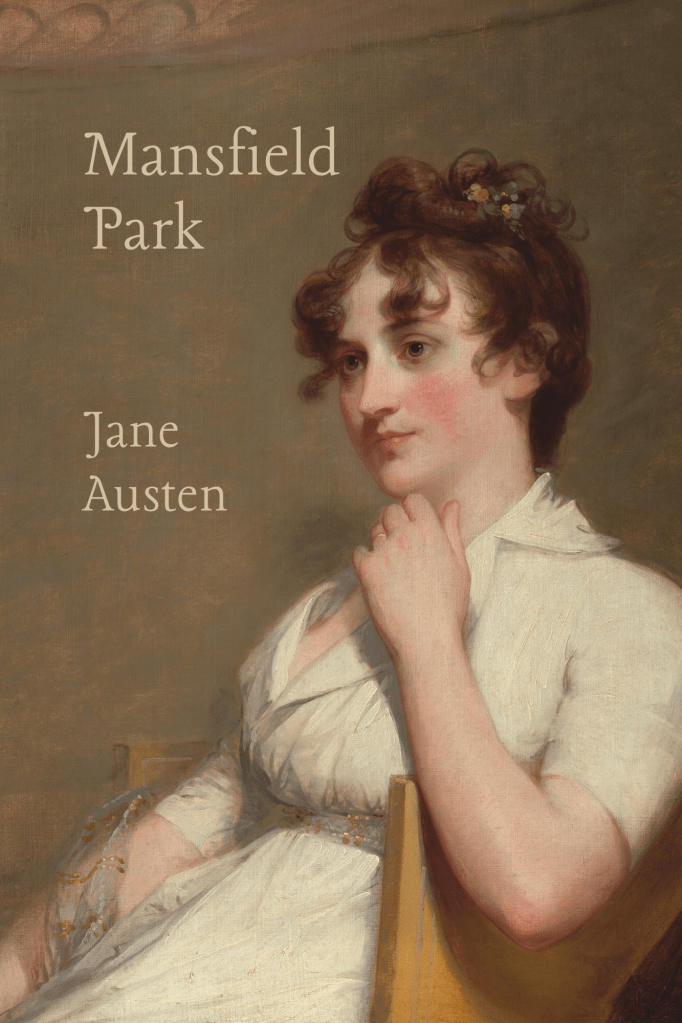
It turns out that the portrait on my Mansfield Park cover is the half-sister of the one who adorns Pride and Prejudice.

I wanted something not too fancy for Fanny Price. I found the simplicity of Gilbert Stuart’s 1804 portrait of Eleanor Parke Custis Lewis (Mrs. Lawrence Lewis). Known as Nelly, she, too, is written of in the National Gallery’s American Paintings of the Eighteenth Century, at pages 237-40.

When she was two and after her father died, she became a ward of George and Martha Washington. She was Martha Washington’s granddaughter and George Washington’s step-granddaughter and adopted daughter. In 1799, she married the Washingtons’ nephew Lawrence Lewis.

The painting shows her to be in the second year of mourning, based on the color of her day dress. In addition to suffering mightily from the death of Martha Washington in 1802, she’d also lost two children. In December of 1804, the year in which the portrait was done, she wrote a friend:

We have both experienced the most severe distress in being deprived of affectionate parents, whose loss can never be repaired. In addition to this, I have lost two children, one of them the most lovely & engaging little Girl I ever saw. I have had very bad health since my marriage until the two last years, I have now recover’d my health, and have two charming children.

In its description, the National Gallery concludes as to Gilbert Stuart:

Stuart’s particular sensitivity may reflect his own ties to Nelly and her family. When he painted President and Mrs. Washington in Philadelphia in the 1790s, Nelly accompanied her grandparents to his Germantown studio for their sittings. The contrast between the vibrant girl whom Stuart had known in Philadelphia and the melancholy young woman he saw in Washington seems to have made an impact on the observant artist.

Nelly Custis Lewis died in 1852.

Austen · Classics · Covers · writing

Covers: Pride and Prejudice

For my conversion of covers to avoid any rights issues, I did searches of those institutions that have Open Access policies, i.e., they allow the use of their images of works in the public domain for any purposes. I searched for portraits in various periods and from various places. This brought up a large number of images, from which I selected a bunch for possible cover use.

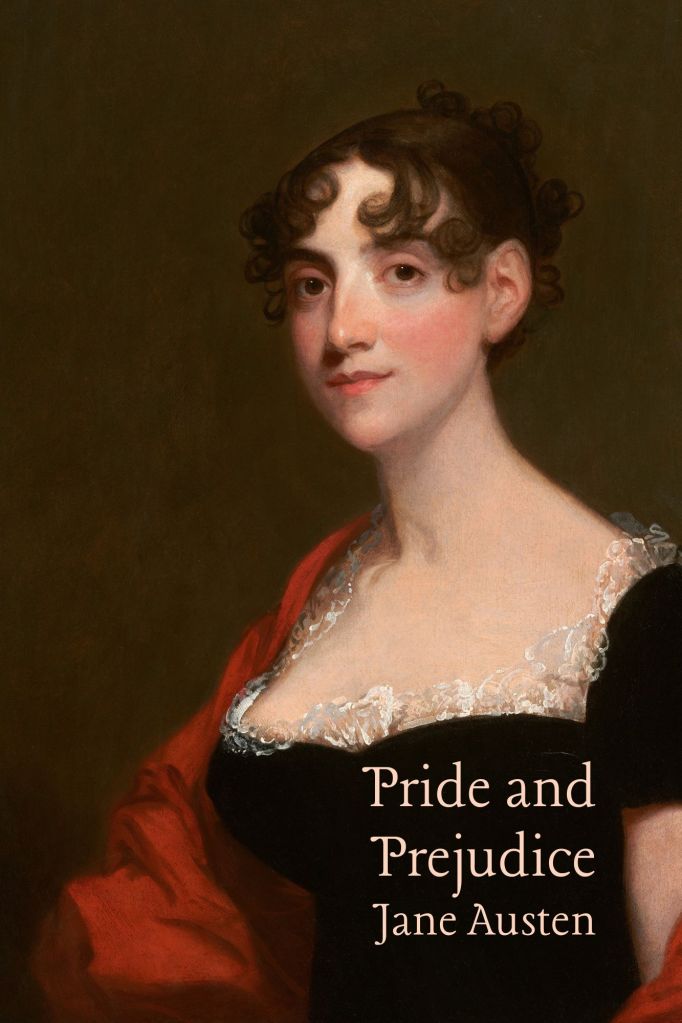
Ann Calvert Stuart Robinson (Mrs. William Robinson), c. 1804, by Gilbert Stuart

Elizabeth Bennet is one of literature’s iconic figures. As I went through my little collection, I wanted someone who could be Elizabeth Bennet. Though for some covers I’ve gone outside the time period, for P&P and my other Austens I needed to keep to it.

The painting I use is of a 19 or 20 year-old and it was done in 1804. So, she is Elizabeth’s age and the date is only a few years before the book’s story. The portrait is from The National Gallery in Washington.

We happen to know quite a lot about the woman in the painting. The National Gallery of Art has several pages about her in its American Paintings of the Eighteenth Century (246-249).

She is Ann Stuart, who was born in Fairfax County, Virginia in 1784. Her aunt described her mother about Ann Stuart and her sister in a manner that will sound familiar to P&P readers: “their mother paid scant heed to their education and brought them up as if they were to marry English lords, and I don’t believe they accept the offers made to them.”

That aunt would later write of her:

The eldest of the Stuart girls is a very nice girl, but she now lives quite far away in Virginia. Her father, whom I am sure you remember as an extremely austere and tedious man — completely respectable, but more knowledgeable about the customs of the Greeks and Romans than of today — forced her against her will to marry a man who does not have enough intelligence to make a woman such as she happy. Although she writes me that she is perfectly [content], I do not believe it.

Ann Stuart wrote to a friend in 1807:

You would be surprised to see what a change has taken place in my taste, instead of reading or writing all day and being out of humor when interrupted I am quite active about the Farm and garden and very solicitous to do something in that way to entitle me to become a member of the agricultural society.

She had two children, boys, and is thought to have died in 1823. She was thirty-nine.

Classics · writing

Covers: Sense and Sensibility

I’ll start with Miss Austen today and her first novel, Sense and Sensibility. It’s the only one of her novels in which I think that there are more than one lead, in this case Elinor and Marianne Dashwood. (I named an MC “Elinor” after the former, who is I think the only Austen MC who doesn’t end up marrying money.)

So this is a rare two-person portrait.

The Cleveland Museum tells us–and one wonders whether their personalities are as varied as are Elinor’s and Marianne’s; “Charlotte (left) and Sarah were 19 and 21, respectively, when this portrait was painted [in 1801] on the occasion of Sarah’s marriage to the topographer Daniel Lysons. The sisters wear fashionable gowns and jewelry, but their affectionate posture conveys a sisterly tenderness that transcends glamour.”